

Five Year Retread
Loss, rebirth, and kitchen time for the wild things

This week marks the fifth anniversary of the world shutting down. Pre-Covid vs. post-Covid still punctuates conversations. And there is no doubt that the Pandemic shifted—some might say transformed—how many things now function.
I lost both my parents to Covid, within 10 days of each other, just before vaccines were widely available. During those early lockdown months, with no work (I’m a professional food stylist, collaborating with commercial photo studios, photographers, and creative agencies), I was at loose ends like so many non-essential workers. My care-giving responsibilities shifted to drive-by visits to my parents’ home, dropping off groceries and at least setting reassuring eyes on my mom. My boys were nearly grown, at school and work. So early on I forced myself outside to wander about, refreshing my stagnant brain with bracing late winter breezes.
A year or so later, as the world (and I) came to terms with its reset, I wrote about my own awakening as I walked for miles in those early Pandemic months. Chronicling my discoveries & the silent rebirth of my own backyard. That essay, with my photos and review of my dabbling with wild food, was my first post at Substack. I didn’t include recipes but described what I saw and tried.
This week I’d like to revive that essay (My Pandemic Wild Side) for any of you who haven’t read it (probably most of you). In today’s post, I include a few of my recipes from that time, documented in my walk-about, then kitchen, journal. I appreciate your taking a few moments to be reflective with me—it was a scary, sad time. But I believe this is a hopeful story of renewal.
This is the filling I made to fill my preserved wild grape leaves—a very fun exercise, especially after often making stuffed grape leaves over the years with ready-made leaves imported from Greece or other parts of the Mediterranean region.
LAMB-RICE DOLMADES FILLING (for brined wild grape leaves)
Makes about 6 cups
Harvest fresh grape leaves when they’re full grown, when still tender but before they get beat up or bug-chewed. To ferment them, wash & dry the leaves, snip off the stems, and stack 8 to 10 leaves. Roll the stacks like cigars, tucking the sides in as you go—I like to tie each bundle with twine. Pack them into 1-quart canning jars & submerge in a salty brine. If you’d like more specific directions, give me a shout. I let the jars stand at room temperature to ferment for about a week, then refrigerate them. Rinse the leaves before filling them. And of course, you can buy jars or cans of preserved grape leaves in Mediterranean markets.
I adapted this recipe from one I found years ago in the Time-Life Foods of the World recipe supplement to the Middle Eastern foods edition from 1969. The groundbreaking series, with its 27 volumes, began in 1968 and finished in the late 1970s. Written by well-known experts on various global cuisines, the books included food-themed travelogues that grounded the featured recipes in cultural context (this was long before Saveur magazine). I often run across copies in used bookstores & they’re worth thumbing through.
INGREDIENTS
2 teaspoons extra-virgin olive oil
1/2 lb. ground lamb
1 medium onion, chopped
6 cloves garlic, finely chopped
2 teaspoons ground baharat seasoning (see below)
1-1/2 teaspoons kosher salt or to taste
Freshly ground pepper
3 cups steamed basmati or sprouted brown rice blend
1 cup chopped fresh dill, cilantro, & mint
1/3 cup chopped green onion
1/3 cup toasted pine nuts
1/3 cup golden raisins or currants
DIRECTIONS
1. Heat oil in large rondeau. Add lamb; break up and sauté till almost all the pink is gone. Drain excess fat if needed. Add onion and garlic; sauté with lamb till tender.
2. Stir in baharat, salt, pepper, and rice. Cook and stir about 5 minutes.
3. Stir in herbs, green onion, pine nuts, and raisins.
4. If making ahead or want some for future dolmades, freeze in smaller containers (you’ll need about 2-1/4 cups for 12 grape leaves.)
5. Lay out brined grape leaves; place a large spoonful of filling in center. Fold leaves over and roll up. Fill as many as desired.
6. Heat a little oil in a large skillet over medium heat. Add grape leaves; cook, turning once, until a bit browned and crisp on outside. Serve hot.
Baharat Seasoning
Makes about ½ cup
INGREDIENTS
2 tablespoons mixed black peppercorns, coriander seeds, and/or cumin seeds (in whatever ratio you’d like)
1 tablespoon allspice berries
1 teaspoon cardamom seeds
½ teaspoon whole cloves
4 (3-inch) cinnamon sticks
1 tablespoon smoked paprika
½ teaspoon freshly grated nutmeg
A spoonful or two ground sumac, if you’d like
Whirl the whole spices in a spice grinder or clean coffee grinder until powdered. Mix with the smoked paprika and grated nutmeg.

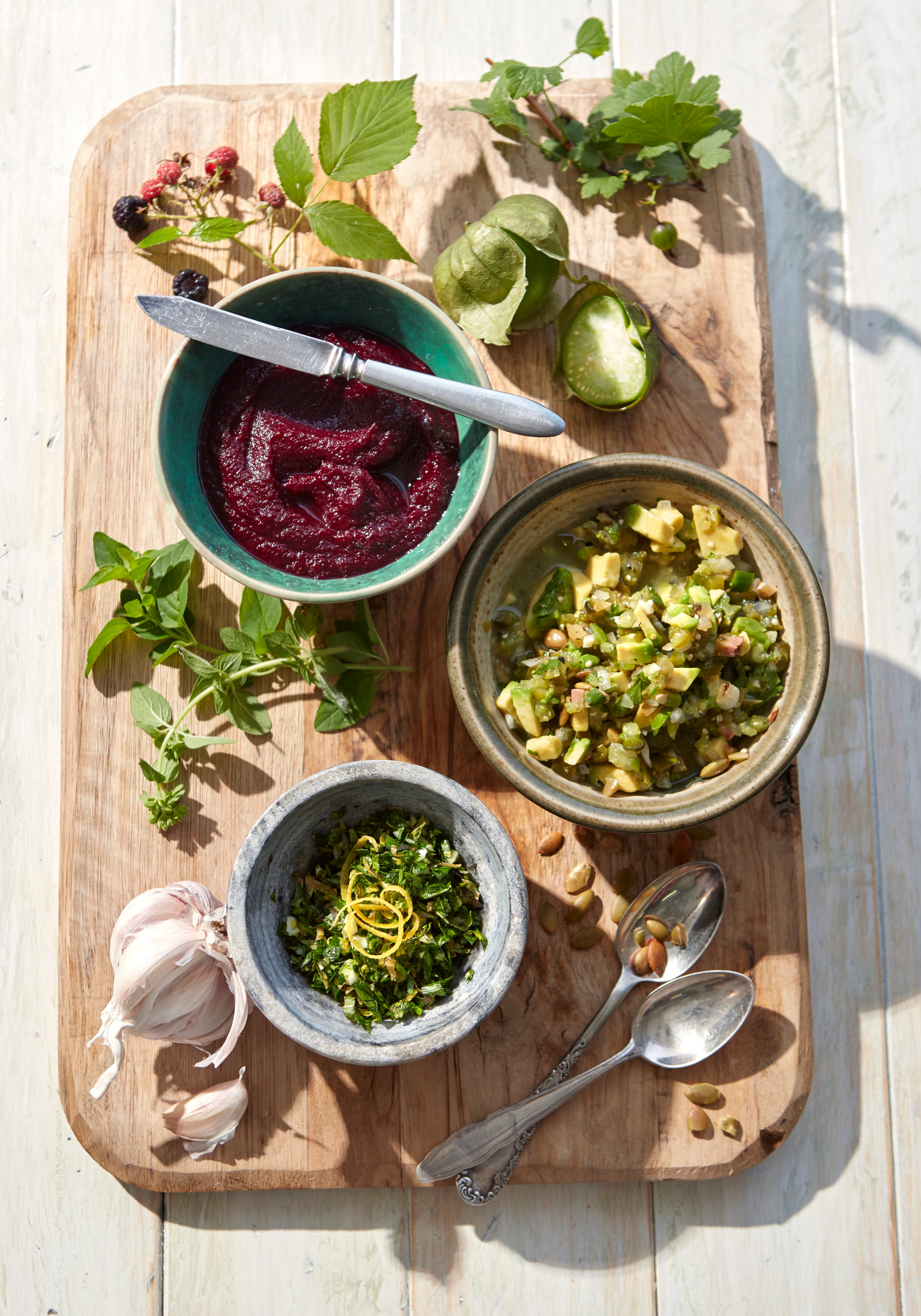
This ketchup, thick & pungently tangy, is really good with grilled meats. Its flavor is always nuanced by what wild berries I can find when I want to make it. I mention making ketchup from wild plums in my earlier post—and will share more about that + other ways with wild plums later this summer.
SPICED BEET & WILDBERRY KETCHUP
Makes 3 cups
Sweet beetroots (I call for red ones here, but golden beets are really lovely too) make a stellar sweet ‘n sour sauce, calling for just a slight perk up of warming spices and a hint of fresh ginger. I’ve been wandering my neighborhood lately, browsing the wild berry bushes that protect the edges of the road, loaded with gem-like sweet raspberries, gooseberries, and currants. Be sure to save the fresh beet stems and greens—chop them up and sauté in a garlicky olive oil with fresh corn or zucchini.
INGREDIENTS
2 ½ lbs. red beets with tops (about 6 medium), trimmed, peeled and coarsely chopped
1 cup wild blueberries, raspberries and/or wild gooseberries
¼ cup chopped onion
1 cup apple cider vinegar
1/3 cup packed brown sugar or honey
1 tablespoon grated fresh ginger
1 teaspoon garam masala
¾ cup water, or as needed
DIRECTIONS
1. Mix beets, berries, onion, vinegar, sugar and ginger in a large saucepan; bring to a boil. Reduce heat; simmer uncovered for about 25 minutes or until beets are tender.
2. Remove from heat; stir in garam masala. Purée the mixture in a food processor fit with the metal blade until smooth, gradually adding as much water as you’d like to get to a desired consistency. Cool. Refrigerate for up to 3 weeks.